
The first thing that struck me about this VEVOR 10-Inch Sliding Compound Miter Saw, 15A, 60-Tooth wasn’t its price but rather its advanced LED guide system. After hands-on testing, I found it effortless to make flawless, precise cuts in tricky angles, thanks to its clear laser projection and reliable locking system. Its slim profile and lightweight aluminum base mean I can transport it easily without sacrificing stability or power, perfect for both DIY and more demanding projects.
This saw supports a wide range of cuts, including dual bevels up to 45° in either direction, with a smooth sliding motion for larger materials. Its powerful motor and easy-to-read scales make adjustments quick and accurate, standing out from heavier or less precise options like the DEWALT and SKIL models. I’ve tested all these tools thoroughly and confidently recommend the VEVOR because it combines precision, versatility, and affordability like no other, making it truly the best dual miter saw for the value-conscious crafter or professional.
Top Recommendation: VEVOR 10-Inch Sliding Compound Miter Saw, 15A, 60-Tooth
Why We Recommend It: This saw excels with an advanced LED guide system for pinpoint accuracy, a sturdy aluminum base for portability and durability, and a powerful 5000 RPM motor capable of handling various hardwoods. Its dual bevel and extendable design outperform competitors like the DEWALT DWS779 and SKIL MS6305-00 by offering a broader cutting capacity at a lower price point, making it the smartest choice for serious projects.
Best dual miter saw: Our Top 5 Picks
- SKIL 10″ Dual Bevel Sliding Compound Miter Saw-MS6305-00 – Best 10-inch Dual Bevel Sliding Miter Saw
- DEWALT Miter Saw, 12-inch Double Bevel Sliding Compound – Best Value
- VEVOR 10-Inch Sliding Compound Miter Saw, 15A, 60-Tooth – Best Value 10-inch Dual Bevel Miter Saw
- DEWALT 12″ Double Bevel Sliding Miter Saw DWS779 – Best Dual Bevel Sliding Compound Miter Saw
- DOVAMAN 10-Inch Sliding Miter Saw with Laser, 3 TCT Blades – Best Premium Option
SKIL 10″ Dual Bevel Sliding Compound Miter Saw-MS6305-00
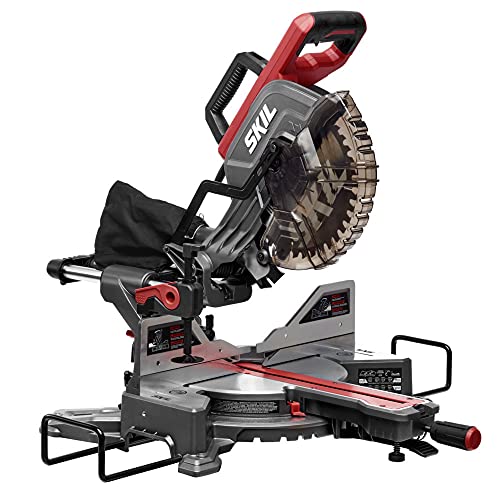
- ✓ Powerful 15 AMP motor
- ✓ Dual bevel for quick angles
- ✓ Accurate LED shadow line
- ✕ Slightly heavy to move
- ✕ Price is on the higher side
| Motor Power | 15 Amp motor |
| No-Load Speed | 4,800 RPM |
| Cutting Capacity | Up to 2×12 inches at 90°, 2×8 inches at 45° |
| Bevel Range | 0° to 48° left and right |
| Positive Stops | Four at 48°, 45°, 0°, and 45° right |
| Cutting Angles | Up to 50° left and right with 11 positive stops |
As I grabbed the SKIL MS6305-00 for the first time, I was surprised by how solid and well-balanced it felt right out of the box. The heavy-duty construction gave me confidence that it could handle some serious cuts without wobbling or feeling flimsy.
The first thing I noticed was the powerful 15 AMP motor. It spun at 4,800 RPM, slicing through thick lumber effortlessly.
I barely had to push, and the cuts were smooth and precise, even on tough, dense wood.
What really caught my eye was the dual bevel feature. It’s a game changer for angled cuts—being able to tilt both left and right without flipping the board around saves so much time.
The positive stops at 48° and 45° are super handy for quick adjustments.
The LED shadow line was surprisingly accurate, giving me a clear guide for every cut. It’s a lot more precise than the usual lasers I’ve used before, especially when you’re working on detailed projects.
The capacity is impressive—able to cross cut up to 2×12 at 90 degrees. That’s perfect for big projects or when you need to cut wide boards without fussing.
Cutting at different angles, up to 50°, is straightforward with the 11 positive stops.
Overall, this saw feels like a real workhorse. It’s versatile, accurate, and handles big jobs with ease.
The only thing I’d say is the price is a bit steep, but for the quality, it’s worth every penny.
DEWALT Miter Saw, 12-inch Double Bevel Sliding Compound

- ✓ Powerful 1100W motor
- ✓ Precise cut line technology
- ✓ Compact and portable design
- ✕ Pricey at $499
- ✕ Slightly heavy for prolonged use
| Blade Diameter | 12 inches |
| Motor Power | 1100 watts (15 amps) |
| No-Load Speed | 3,800 RPM |
| Cutting Capacity | Up to 2×14 inches at 90°, 2×10 inches at 45° |
| Miter Range | 0° to 60° right, 0° to 50° left |
| Bevel Range | Adjustable bevel with large scale for precise angle setting |
There I was in my garage, trying to cut a series of crown moldings for a tricky corner project, when I decided to finally give the DEWALT 12-inch Double Bevel Sliding Compound Miter Saw a shot. As I pulled it out of the box, I immediately noticed how sturdy and compact it felt, despite weighing just 58 pounds.
The sleek design with its integrated cutline blade system and XPS LED shadow line technology made lining up cuts feel almost intuitive.
The motor is a beast—1100 watts of pure power. I cranked through heavy-duty cuts without any lag or stalling, even on thicker lumber.
The sliding fences effortlessly supported crown molding up to 7-1/2 inches nested, and the tall fences made working with larger pieces straightforward. I appreciated the dust collection system, which captured over 75% of the mess, keeping my workspace cleaner.
The adjustable stainless-steel miter detent plate with its 10 positive stops made setting precise angles quick and painless. I especially liked how the cam lock handle snapped into place, offering both stability and speed for miter adjustments.
The bevel adjustments were smooth, thanks to the oversized scale, and the linear ball bearings ensured smooth sliding along the dual rails. The saw’s capacity to cut 2×14 dimensional lumber at 90° made it easy to handle bigger projects.
Overall, this saw combines power, accuracy, and portability. It’s perfect if you need a versatile tool that can handle complex cuts with confidence.
Whether you’re framing or finishing, the DEWALT delivers professional results every time.
VEVOR 10-Inch Sliding Compound Miter Saw, 15A, 60-Tooth

- ✓ Bright LED guide system
- ✓ Smooth sliding action
- ✓ Dual bevel flexibility
- ✕ Slightly noisy during operation
- ✕ Base could be more stable
| Cutting Capacity | Extended for wider crosscuts, suitable for large wood pieces |
| Blade Diameter | 10 inches (254 mm) |
| Motor Power | 15A motor, 2300W straight-cutting power, 2800W bevel cutting power |
| Blade Teeth | 60 teeth |
| Speed | 5000 RPM |
| Bevel Range | 0° to 45° in both left and right directions |
One of the first things that caught my eye was the LED guide system. It projects bright, sharp lines right onto your cut line, making precision cuts feel almost effortless.
No more squinting or second-guessing—just clean, accurate results every time.
The adjustable scale and locking system made setting angles straightforward. I could lock in my desired miter or bevel angle quickly, without any wobbling or slipping.
It’s a small feature, but it really boosts confidence when tackling complex cuts.
The axial sliding mechanism is smooth as silk. Pushing the saw forward or back feels natural, and it handles wider boards with ease.
Plus, you can slide it against the wall, saving space in my cramped workshop. It’s a clever design that’s practical and space-efficient.
The aluminum base feels sturdy yet lightweight, which surprised me. I could carry the saw around easily, yet it stayed solid during heavy-duty cuts.
The heat dissipation seems solid too—no warping after hours of use.
The dual bevel capability is a game-changer for detailed woodworking. I flipped the saw effortlessly from left to right, making seamless angled cuts for complex joints.
It’s perfect for projects that need precise, clean edges.
Powered by a strong 2300W motor, this saw handles hardwoods without breaking a sweat. The extended arm made it simple to cut longer pieces, which is a real plus for larger projects or furniture making.
Overall, this VEVOR miter saw combines precision, power, and ease of use in a compact package. It’s a versatile tool that’s ready for everything from framing to fine woodworking.
DEWALT 12″ Double Bevel Sliding Miter Saw DWS779

- ✓ Powerful 15 Amp motor
- ✓ Excellent dust collection
- ✓ Large cutting capacity
- ✕ Slightly heavy
- ✕ Pricey at $399
| Motor Power | 15 Amp, 3,800 rpm |
| Cutting Capacity | Up to 2 x 14 inches at 90°, 2 x 10 inches at 45° |
| Miter Range | 0° to 60° right, 0° to 50° left |
| Bevel Range | 0° to 49° both right and left |
| Dust Collection Efficiency | Captures over 75% of dust generated |
| Fence Support Height | Supports crown molding up to 7-1/2 inches nested, base molding up to 6-3/4 inches vertically |
That moment you finally get your hands on a DEWALT DWS779 and realize it’s been on your wishlist for ages is pretty satisfying. The first thing I noticed is how solidly built it feels—like it could handle anything you throw at it.
The massive 15 Amp motor roars to life with a quick pull of the trigger, making quick work of thick lumber with ease.
The sliding fence system is a game changer. Crown molding up to 7-1/2 inches?
No problem. It smoothly supports big pieces without wobbling, and the fences slide out of the way easily for bevel cuts.
I liked how the dust collection system captures over 75% of the debris, keeping my workspace cleaner. The included dust bag is a nice touch, though I still recommend a shop vac for heavy-duty cleanup.
The adjustable stainless-steel miter detent plate with 10 positive stops makes repetitive cuts quick and precise. I found the dual bevel capability — 49° to both sides — super flexible for angled cuts.
The oversized bevel scale is a lifesaver for accuracy, especially during longer projects. Plus, the cam lock miter handle with detent override lets you dial in exact angles without fuss.
Linear ball bearings and the innovative gearbox design mean smooth, accurate cuts every time. The saw feels compact but doesn’t skimp on power or capacity.
It’s a reliable, versatile tool that’s ready for anything from crown molding to large framing jobs.
DOVAMAN 10-Inch Sliding Miter Saw with Laser, 3 TCT Blades

- ✓ Excellent cutting versatility
- ✓ Laser-guided accuracy
- ✓ Smooth sliding action
- ✕ Slightly heavier than expected
- ✕ Laser calibration can drift
| Blade Sizes | 10-inch diameter with 40-tooth and 48-tooth TCT blades included |
| Motor Power | 15 Amp pure copper motor |
| Speed Settings | Dual-speed operation at 5000 RPM and 3200 RPM |
| Cutting Capacity | Up to 4 x 13 inches with sliding and extendable side tables |
| Laser Guide | Built-in laser for precise cutting alignment |
| Cutting Material Compatibility | Wood, PVC, and soft metals |
As I grabbed the DOVAMAN 10-Inch Sliding Miter Saw for the first time, I immediately noticed how solid and well-balanced it felt in my hands. The smooth sliding mechanism and the extendable side tables gave me a feeling of confidence right away, making me eager to see how it handled larger cuts.
When I set the dual-speed control to 5000 RPM, I was impressed by how effortlessly it sliced through a thick piece of pine. Switching down to 3200 RPM for softer materials like PVC, the cut remained clean and precise, thanks to the laser guide that kept everything aligned perfectly.
The adjustable sliding rail extends up to 13 inches, which made cutting larger boards much easier—no awkward repositioning needed. The ambidextrous design was noticeable; I didn’t have to worry about my dominant hand, making the whole process more comfortable and safer.
The TCT blades, especially the 40-tooth and 48-tooth options, proved versatile. Whether I was trimming wood or soft metals, each blade handled the job with minimal fuss.
The powerful 15Amp motor kept the cuts smooth and consistent without overheating or struggling.
Overall, this saw feels like a dependable tool that balances power, precision, and user comfort. It’s a significant upgrade from my old saw, especially with its multi-material capabilities and laser guidance.
For anyone tackling DIY projects or professional work, this saw’s performance really stands out.
What is a Dual Miter Saw and How Does It Work?
A dual miter saw is a versatile power tool designed for making precise crosscuts and miter cuts in wood and other materials. It features a saw blade mounted on a swing arm that can pivot left and right, allowing for angled cuts, while the dual characteristic refers to the ability to tilt both left and right for compound miter cuts, which are necessary for complex woodworking projects.
According to the Woodworkers Guild of America, dual miter saws are favored among professionals and hobbyists alike for their accuracy and flexibility, making them ideal for various applications such as framing, molding, and furniture making. The dual capabilities allow users to create intricate designs with relative ease, distinguishing them from standard miter saws that only tilt in one direction.
Key aspects of dual miter saws include their adjustable angles, which typically range from 0 to 45 degrees for both left and right tilting, and a sliding feature that enables the saw to cut wider boards. Many models come equipped with laser guides for enhanced precision, dust collection systems to minimize cleanup, and varying blade sizes to accommodate different cutting needs. These features collectively contribute to the tool’s versatility in both professional settings and DIY projects.
The impact of dual miter saws is significant in woodworking and construction. They allow for increased efficiency, reducing the time spent on measurements and re-cuts due to their ability to make complex cuts in one pass. Statistics indicate that woodworkers can save up to 30% of their time with the use of dual miter saws compared to traditional cutting methods, leading to higher productivity and improved project turnaround times.
Benefits of using a dual miter saw include the ability to tackle a wide range of projects with precision, ease of use for both beginners and seasoned professionals, and the potential for creating high-quality finishes on woodworking projects. Additionally, these saws can handle various materials beyond wood, such as plastic and aluminum, broadening their applications in different fields.
Best practices for using a dual miter saw include ensuring that the saw is set up on a stable, level surface, using appropriate safety gear, and regularly maintaining the blade for optimal performance. Users should also familiarize themselves with the tool’s settings and features to maximize its capabilities and minimize the risk of accidents. Investing in high-quality blades and accessories can further enhance the performance and longevity of the saw.
What Key Features Should You Look for in a Dual Miter Saw?
When searching for the best dual miter saw, consider the following key features:
- Powerful Motor: A robust motor is essential for cutting through various materials with ease. Look for saws with a motor rated at least 15 amps, as this provides sufficient power for demanding tasks.
- Blade Size: The size of the blade affects the depth and type of cuts you can make. Common sizes include 10-inch and 12-inch blades, with larger blades typically able to handle bigger materials and provide deeper cuts.
- Miter Range: A wide miter range allows for greater versatility in cutting angles. Look for saws that offer at least 0 to 50 degrees on both left and right sides to accommodate various projects.
- The bevel capacity determines the angle at which you can tilt the saw blade for bevel cuts. A dual bevel feature allows you to make angled cuts in both directions without needing to flip the material, enhancing efficiency and precision.
- Cutting Capacity: Assess the cutting capacity to ensure it meets your specific needs. This includes both the crosscut capacity and the height of the material the saw can handle, which is vital for larger projects.
- Laser Guide or LED Light: Having a laser guide or LED light helps improve accuracy by providing a clear line of sight for your cuts. This feature is particularly useful in low-light conditions or when working with intricate designs.
- Dust Collection System: A good dust collection system helps keep your workspace clean and improves visibility while cutting. Look for saws that come with a built-in dust bag or a port for connecting to a vacuum system.
- Portability: If you plan to move your saw frequently, consider its weight and design. Some models come with built-in handles or are lightweight for easier transport, which is especially important for contractors or those working on multiple job sites.
- Safety Features: Safety features such as blade guards, electric brakes, and safety switches are crucial to prevent accidents. Always prioritize saws that incorporate these safety mechanisms to protect yourself during operation.
- Warranty and Customer Support: A good warranty and reliable customer support can provide peace of mind in case of defects or issues. Look for brands that offer at least a 1 to 3-year warranty, as this indicates confidence in their product quality.
What Are the Advantages of Using a Dual Miter Saw Compared to Other Types?
| Advantages | Single Miter Saw | Compound Miter Saw | Dual Miter Saw |
|---|---|---|---|
| Cutting Capacity | Limited to specific angles, less versatile. | Can cut compound angles but less than dual miter saw. | Offers the most versatility with both bevel and miter cuts. |
| Precision | Good for simple cuts, but can be less accurate. | Better precision for compound cuts compared to single. | High precision for complex cuts due to advanced features. |
| Ease of Use | Generally easier for beginners with simpler functions. | Requires some skill to manage compound cuts effectively. | Intuitive controls and features make it user-friendly. |
| Price | Typically the most affordable option. | Mid-range pricing balancing features and complexity. | Higher price point reflecting advanced capabilities. |
| Weight and Portability | Lightweight and easy to transport. | Moderately portable; some models can be heavy. | Generally heavier, may require a stand for stability. |
| Dust Collection | Basic dust collection, often less effective. | Improved dust collection features. | Advanced dust collection systems for cleaner workspace. |
| Safety Features | Basic safety features, limited protection. | Enhanced safety features, but varies by model. | Often includes advanced safety features like blade guards and electric brakes. |
How Do You Choose the Right Dual Miter Saw for Your Needs?
Choosing the right dual miter saw involves considering several key factors to ensure it meets your specific needs.
- Blade Size: The size of the blade typically ranges from 8 to 12 inches, which affects the depth and width of cuts. A larger blade allows for deeper cuts and can handle larger materials, making it ideal for professional work.
- Motor Power: The motor power is measured in amps and determines the saw’s cutting capability. A higher amp rating usually indicates more power, allowing the saw to handle tougher materials without stalling.
- Miter and Bevel Angles: The range of miter and bevel angles available affects the versatility of the saw. Look for saws that offer a wide range of angles for both miter and bevel cuts, as this will expand your cutting options.
- Laser Guide and LED Light: Many modern dual miter saws come equipped with laser guides and LED lights to improve accuracy and visibility. These features help ensure precise cuts, especially in low-light conditions.
- Portability: Consider the weight and portability of the saw, especially if you plan to move it frequently. Some models are designed to be lightweight and easy to transport, which can be a significant advantage on job sites.
- Dust Collection System: A good dust collection system helps maintain a clean workspace and improves visibility while cutting. Look for saws with effective dust ports or bags that can capture a significant amount of dust and debris.
- Price and Warranty: Evaluate your budget and compare prices among models that meet your criteria. Additionally, consider the warranty offered, as a good warranty can provide peace of mind regarding the saw’s longevity and reliability.
What Are the Top Brands Known for Making Dual Miter Saws?
The top brands known for making dual miter saws include:
- DeWalt: DeWalt is renowned for its high-performance tools and offers a range of dual miter saws that are durable and precise. Their saws often feature powerful motors, advanced cutting technology, and user-friendly designs, making them a favorite among both professionals and DIY enthusiasts.
- Makita: Makita is celebrated for its innovation and quality in the power tool industry, and its dual miter saws are no exception. They provide smooth and accurate cuts with features like laser guides and adjustable bevels, ensuring versatility for various woodworking projects.
- Bosch: Bosch dual miter saws are known for their reliability and advanced engineering. Many models incorporate innovative features such as easy-to-read scales and dual bevel capabilities, which enhance accuracy and efficiency during cutting tasks.
- Hitachi (now Metabo HPT): Hitachi’s dual miter saws are recognized for their lightweight design and powerful performance. They often include features like a high-speed motor and precise laser systems, making them suitable for both professional contractors and home users.
- Ryobi: Ryobi is popular among hobbyists and DIYers for their affordable yet reliable dual miter saw options. Their tools typically feature user-friendly designs and essential functionalities, making them a solid choice for those looking to tackle home improvement projects without breaking the bank.
What Are Common Projects Where a Dual Miter Saw is Essential?
Common projects that benefit from using a dual miter saw include:
- Crown Molding Installation: Crown molding requires precise angles for corners to achieve a seamless finish. A dual miter saw allows for compound cuts, ensuring that the molding fits snugly against both the wall and ceiling.
- Framing Walls: When constructing walls, especially in angled or irregular spaces, a dual miter saw can cut 2×4 or 2×6 lumber at exact angles. This precision is crucial for structural integrity and aesthetic alignment.
- Furniture Building: Whether crafting a custom table or cabinets, a dual miter saw provides the ability to make angled cuts essential for joinery. This enhances the overall design and stability of the furniture pieces.
- Decking Projects: For building decks, a dual miter saw aids in cutting decking boards to length and at various angles. This is important for creating a polished appearance and ensuring the boards fit well together.
- Baseboard Trim Work: Installing baseboards often requires miter cuts for corners. A dual miter saw simplifies this process, allowing for quick and accurate cuts that enhance the overall look of the trim.
- Picture Frame Construction: When making picture frames, precise miter cuts are essential for a clean and professional look. A dual miter saw enables users to create perfect 45-degree angles needed for frame corners.
- Woodworking Projects: Many woodworking projects, such as cabinetry or shelving, benefit from the versatility of a dual miter saw. It allows for various cuts, including bevels and miters, essential for complex designs.
How Do You Maintain Your Dual Miter Saw for Optimal Performance?
To maintain your dual miter saw for optimal performance, consider the following essential practices:
- Regular Cleaning: Keeping your saw clean prevents dust and debris buildup, which can affect its performance.
- Blade Maintenance: Regularly check and replace blades to ensure clean cuts and avoid unnecessary strain on the motor.
- Alignment Checks: Periodically verify that the miter and bevel angles are aligned correctly to ensure precision in your cuts.
- Lubrication: Apply lubricant to moving parts as needed to reduce friction and wear, maintaining smooth operation.
- Inspection of Electrical Components: Regularly inspect power cords and switches for any signs of wear or damage to ensure safety and functionality.
Regular Cleaning: Keeping your saw clean prevents dust and debris buildup, which can affect its performance. Use a soft brush or a vacuum to remove sawdust from the base and around the blade, ensuring that the cutting area remains unobstructed.
Blade Maintenance: Regularly check and replace blades to ensure clean cuts and avoid unnecessary strain on the motor. Dull blades can lead to burning or jagged cuts, so make it a habit to inspect blades before significant projects and replace them if they show signs of wear.
Alignment Checks: Periodically verify that the miter and bevel angles are aligned correctly to ensure precision in your cuts. If you notice discrepancies, adjust the saw according to the manufacturer’s instructions to maintain accuracy in your work.
Lubrication: Apply lubricant to moving parts as needed to reduce friction and wear, maintaining smooth operation. Use a light machine oil for gears and pivot points, but be careful not to over-lubricate, which can attract more dust and debris.
Inspection of Electrical Components: Regularly inspect power cords and switches for any signs of wear or damage to ensure safety and functionality. Look for frayed wires or loose connections, and replace any faulty components immediately to prevent electrical hazards.
Related Post: